The Great Waffle House Crusade
Lately I've been getting questions about my IM profile, which declares the continued march of the Great Waffle House Crusade. People want to know: "What is this Waffle House Crusade?" "How can I join?" "Is it tax exempt?" "Will it be more successful than the actual medieval crusades?"
Well, in order to inform you, the reading public, about the Crusade, let me take you back into history to reveal one of the great epics of the age of mankind.
 Sébastien de Gaufre and the First Crusade
Sébastien de Gaufre was a young French noble in the late 11th Century. When, in 1095, Pope Urban II asked for support in taking control of Palestine, Sébastien volunteered. Although he was a favorite of French king Philippe I, who asked him no to go, Sébastien was adamant, and his king assented.
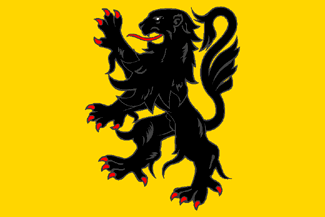
Sébastien's lineage traced back to prominent Breton nobles (from Brittany, in northwest France) on his father's side and from Flanders on his mother's. As his personal colors, he adopted the black stripes of Brittany on the yellow banner of Flanders. On his shield was the red cross of the Crusaders. He set out for the Holy Land early in 1096 with the armies of Philip's brother, Hugh of Vermandois; the brother of William the Conqueror, Robert of Normandy and Stephen, Count of Blois also joined the French expedition.

Sébastien de Gaufre
During the Crusade, Sébastien encountered one man who would change his life. A German prince, Denis von Bayern, accompanied Peter the Hermit of Amiens who led a wave Germans through southern Europe and into Constantinople. Although most of that force was killed by Seljuk Turks after crossing into Asia Minor, Peter and Denis surivived to meet up with the main Crusader forces, including Sébastien.
Sébastien and Denis were formidible fighters and gathered about them a group of Knights who fought the Muslim warriors in the Holy Land. Like the other famous orders of knights of the Crusades, the Knights Templar, the Knight Hospitaller and the Teutonic Knights (actually formed in the 12th century), the Knights of Sébastien and Denis prized their faith and their martial skill above all else. Selection into the Order was rigorous and secretive, and their Order was renown for it's prowess in battle.

Denis von Bayern
The Order was formed at a Holy Mass said in Jerusalem, the first performed there after its conquest. Sébastien and Denis, in awe of the array of peoples and nations represented, decided to take the best fighters of the Crusader nations for their Order. Focusing on their common linkage by the Body of Christ and their shared participation in the sacrement of Communion, the Order became known as the Order of the International Knights of the Communion Wafer.
The First Crusade established in Palestine four Crusader States and by 1100, the First Crusade was considered accomplished.
However, the victory was not to last. Sébastien and his knights were to govern the Crusader State known as the County of Edessa, the eastern-most state in what is now southeastern Turkey. Successfully helping the Counts of Esdessa for nearly forty years, the Knights of the Wafer tried to keep the peace in a foreign land. Both Sébastien and Denis became trusted advisers to the succession of Counts who ruled Edessa. However, the County was ill-fated and under constant attack from the Byzantines, Turks, and other natives.
In the year 1144, both Sébastien and Denis were very old, each near seventy, most historians estimate, when Denis fell from grace. Imad ad-Din Zengi, a local warlord, after successfully fighting the Byzantines who had conquered the crusader state of Antioch, himself attacked Edessa. Denis von Bayern, who thought that Count Joscelin II of Edessa favored Sébastien, made a deal with Zengi to leave the County open to attack in exchange for riches and a safe passage out of the Middle East to Europe.
Zengi kept his part of the bargain and Denis fled Palestine for Bavaria with a large group of the knights. When he arrived in Europe, he told of the news of the conquerng of Edessa and said that he had been sent back by Joscelin to warn the pope. The pope, Eugenius III, called for a Second Crusade. Denis had said that Sébastien had betrayed the Count and opened the way for Zengi to attack. Throughout Europe, Sébastien was branded a traitor. Upon hearing the news, Louis VII, king of France and grandson of Sébastien's former master, King Philippe I, stripped Sébastien's family of their titles and lands and burned the villiage where he had been born. Advisers of Louis said that the king had been so grief-stricken at the treachery of his father's champion, that he shut himself in his chambers for a month. Meanwhile, Pope Eugenius III, in effort to raise support for his Second Crusade, declared Sébastien a heretic and had him excommunicated from the Church.
The Maison du Gaufre
Meanwhile, in Palestine, Sébastien realized that he had been betrayed by his closest friend. With Zengi's forces pouring in to Edessa, the aging Sébastien vowed to fight every invader. Sébastien's knights, however, revered their master, and begged him to return to Europe to clear his good name, call upon the Pope for help, and kill Denis and his traitorous knights. Sébastien agreed and took with him a group of his best warriors and set out secretly for Europe.
The journey took nearly a year, but over that time, Sébastien and his remaining knights vowed to avenge themselves on Denis. Once in the Holy Roman Empire, Sébastien learned that Denis had lied to the Pope and that he had painted Sébastien as the traitor. The grief was said to have broken Sébastien's heart, particularly when he heard what had happened to his family (his extended family, he had no wife of his own) and when he learned of how saddened the king had been. The old knight had wnough strength to return to Flandrs, his mother's home in what is now Belgium, where he died surrounded by his knights.
The knights who had returned with him from the Holy Land swore to hunt down Denis and his knights and destroy them all for having caused the death of their master and for having brought about the fall of the County, which they were charged to protect. The knights took up the name "La Maison du Gaufre," or "the House of de Gaufre," as a tribute to their leader and adopted his colors, black and yellow as their own.
The International Knights of the Communion Wafer, however, had become even more powerful, using the riches they had been granted by Zengi to gain power and influence, particularly in the court of Heinrich III, the Holy Roman Emperor. The war of Sébastien's followers would have to be a secret one.
The Waffle Crusade Begins
The followers of Sébastien and Denis would fight for centuries, secretly and overtly, leading down to the Waffle House Crusade of today. My next post will follow the underground war as it shaped events in Europe and around the world, until coming to America where the battles rage on to this day...
posted by Graham at 19:14






0 Comments:
Post a Comment
<< Home